




Kathmandu. Cooperation between Nepal’s National Human Rights Commission and Malaysia’s Human Rights Commission (SUHAKAM) has been expanded with a renewed focus on protecting the human rights of nearly 400,000 Nepali workers employed in Malaysia.
The two commissions have renewed a three-year memorandum of understanding (MoU) aimed at protecting the rights of migrant workers and people residing in both countries.

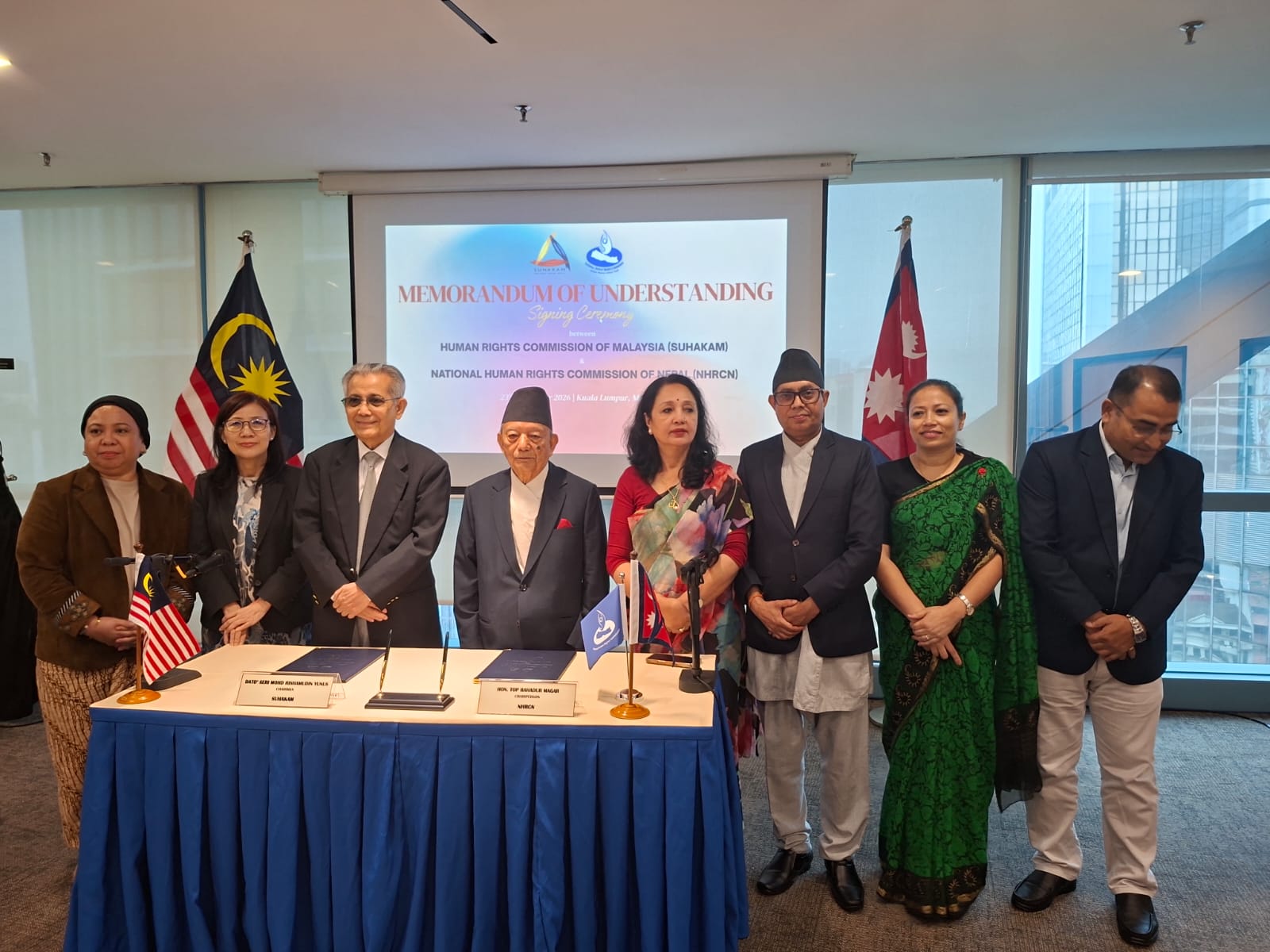
The MoU was signed on Wednesday at SUHAKAM’s headquarters in Kuala Lumpur by SUHAKAM Chairman Dato’ Seri Mohd Hishamudin Yunus and Chairperson of Nepal’s National Human Rights Commission, Top Bahadur Magar. The renewed agreement will remain in effect from 2026 to 2028.

The agreement provides a framework for the two human rights bodies to jointly address human and labor rights issues faced by Nepali workers in Malaysia. The two sides will cooperate on exchanging information related to complaints, bilateral communication, joint monitoring, investigations and other activities aimed at protecting workers’ rights.

Such an agreement was first signed in 2019 and was renewed twice thereafter, remaining in effect until 2024. The large number of Nepali workers in Malaysia and the nature of the problems they face have highlighted the need for stronger monitoring and institutional cooperation.

According to SUHAKAM, it received 46 complaints involving alleged human rights violations against Nepali workers between 2021 and August 2026.
The complaints include employers withholding workers’ passports, requiring them to work up to 12 hours a day, denying leave for up to 30 consecutive days, withholding or delaying wages, failing to provide overtime pay and providing unsafe workplaces or inadequate safety measures.
The renewed agreement prioritizes investigation and monitoring of such issues. The two commissions will cooperate in investigating alleged human rights violations involving Nepali workers, monitoring detention centers and possible human rights violations there, and addressing the high death rate among migrant workers.
The agreement also covers policy advocacy concerning recruitment fees charged to Nepali workers and the risk of forced labor. The two sides have agreed to engage with Malaysia’s Social Security Organisation (SOCSO/PERKESO) to improve Nepali workers’ access to social security schemes and to jointly protect the rights of female migrant workers, particularly those in vulnerable and informal employment.
Both commissions will review worker-related policies from a human rights perspective, provide recommendations to the respective governments to improve access to justice and cooperate in capacity-building for personnel in Nepal’s security sector.
Following the renewal, Nepal’s National Human Rights Commission has also begun consultations with relevant stakeholders to assess the current situation of Nepali workers in Malaysia. An NHRC team met with officials at the Nepali Embassy in Kuala Lumpur and representatives of the Non-Resident Nepali Association (NRNA) Malaysia to gather information about workers’ conditions and the problems they face.
SUHAKAM has also said it has arranged meetings with Malaysia’s Prisons Department and SOCSO as part of the implementation of the agreement.
Recent complaints indicate that the problems faced by Nepali workers in Malaysia extend beyond employment and wage-related issues. Passport retention, excessive working hours, delayed wage payments, non-payment of overtime and inadequate workplace safety are directly linked to workers’ rights.
Against this backdrop, the two commissions have urged Nepali workers who have experienced or witnessed possible human rights violations in Malaysia to file complaints with SUHAKAM. Complaints will be handled in accordance with SUHAKAM’s procedures for complaint management and confidentiality.
The renewed three-year agreement provides a clearer institutional mechanism for addressing the concerns of Nepali workers in Malaysia. Its effectiveness will depend on the investigation of complaints, regular monitoring, access to justice, social security coverage and concrete intervention in cases of human rights violations. For a cooperation mechanism affecting nearly 400,000 Nepali workers, effective implementation will be a key challenge.